
Think Gum Review: Does This Brain-Boosting Gum Actually Work?


Ever wished you could chew a piece of gum and instantly feel smarter?
That is exactly the promise behind Think Gum. Originally created by a college student looking for better focus during late-night study sessions, this brain-boosting chewing gum claims to help improve memory, increase concentration, and keep you mentally alert.
But does it actually work?
In this review, we break down the ingredients, the science behind the claims, the flavor, and how Think Gum compares to newer energy gums on the market.
Table of Contents
Think Gum Review: Quick Facts About Think Gum
Goal: Designed to enhance memory and concentration
Energy: Contains 20 mg of natural caffeine per serving
Flavor: Strong herbal peppermint
Science: Backed by a published study on memory performance
Important Note: Contains Vinpocetine, which the FDA warns pregnant women to avoid
What Are People Saying
Everyday Scientist Review

Source: https://blog.everydayscientist.com/think-gum/
Candy Favorites Review

Source: https://www.candyfavorites.com/products/think-gum?srsltid=AfmBOooAUemts89nSFuXbgRExznzDpH7Xg8GZRCAVLW7Ew-FQqzIk8fr
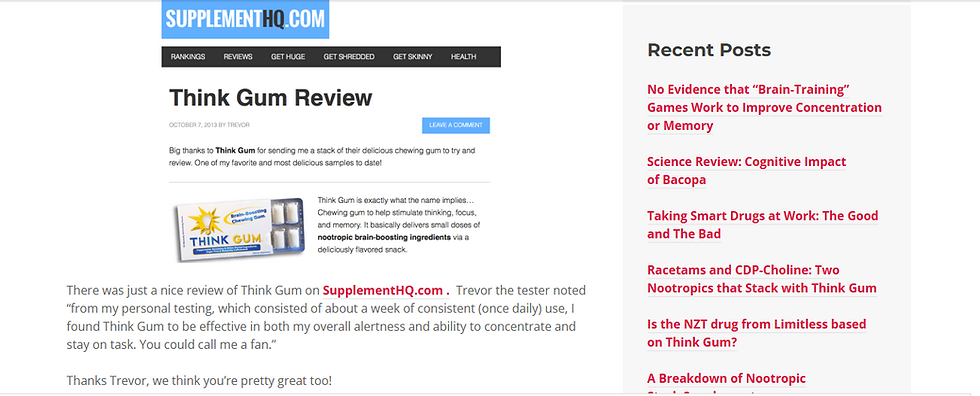
Source: http://www.supplementhq.com/think-gum-review/
What Exactly Is Think Gum?
Think Gum is not your average chewing gum. It belongs to a category known as functional gum, meaning it is designed to deliver active ingredients that may support mental performance.
The product launched in 2007, making it one of the earliest pioneers in the nootropic gum space.
The idea came from Matt Davidson, a student at UC Berkeley who later developed the product while completing his PhD at Stanford.
His goal was simple: combine caffeine with traditional herbal ingredients known for supporting brain function.
But why use gum instead of capsules or pills?
Two reasons stand out.
First, research suggests that chewing gum can increase blood flow to the brain, which may support alertness.
Second, chewing a specific flavor while studying and then chewing that same flavor again during recall may help trigger memory associations.
This phenomenon is sometimes referred to as context-dependent memory.
Breaking Down the Brain-Boosting Ingredients
Think Gum uses a blend of herbal ingredients designed to support focus, memory, and cognitive performance.
Here is a closer look at what is inside the formula.
Guarana for Gentle Energy
Instead of synthetic caffeine, Think Gum uses guarana, a plant native to the Amazon that naturally contains caffeine.
A serving of Think Gum, or two pieces, contains 20 mg of caffeine.
For comparison:
Coffee: about 95 mg
Energy gums: often 40 to 50 mg per piece
This means Think Gum provides a very mild energy boost.
For people sensitive to caffeine, this may be ideal. For heavy coffee drinkers, it may feel too light.
Bacopa Monnieri for Memory
Bacopa Monnieri is widely used in traditional Ayurvedic medicine.
Research suggests Bacopa may help support:
memory recall
learning ability
cognitive processing speed
However, Bacopa typically works best when taken consistently over several weeks, so immediate effects from a single piece of gum may be limited.
Ginkgo Biloba for Cognitive Support
Ginkgo Biloba is one of the most widely studied herbal supplements for brain health.
Some studies suggest it may help improve circulation to the brain and support cognitive performance.
However, results across scientific studies remain mixed.
Peppermint and Rosemary for Aromatic Effects
Think Gum also uses aroma-based stimulation.
Research suggests:
Peppermint scent may increase alertness
Rosemary aroma may support memory performance
Because chewing gum releases aroma continuously while chewing, these scents may provide subtle cognitive stimulation.
The Controversial Ingredient: Vinpocetine
One ingredient in Think Gum deserves special attention.
Vinpocetine is a synthetic compound derived from the periwinkle plant.
It is often used in supplements intended to increase blood flow to the brain.
However, the U.S. Food and Drug Administration has issued safety warnings about Vinpocetine, especially for pregnant women or women who may become pregnant.
The FDA warns that Vinpocetine may cause pregnancy complications.
Because of this, individuals in that category should avoid Think Gum entirely.
Does the Science Actually Hold Up?
One of the most interesting aspects of Think Gum is that it has published scientific research examining the product itself.
A study published in the journal Appetite compared three groups:
participants chewing Think Gum
participants chewing regular gum
participants chewing no gum
The results showed that participants chewing Think Gum performed better in certain short-term and long-term memory tests.
However, it is important to note that the study was conducted by the creator of the gum, which introduces potential bias even though the research was peer reviewed.
Still, having product-specific research is rare in the chewing gum industry.
What Does Think Gum Actually Taste Like?
Flavor is one of the biggest talking points about Think Gum.
Because Think Gum contains real herbal extracts like Bacopa and Ginkgo, the taste is noticeably stronger and more earthy.
Many users describe the initial flavor as:
bitter
herbal
medicinal
After about a minute of chewing, the intense herbal notes usually fade, leaving a more traditional peppermint flavor.
The company even suggests thinking of Think Gum more like a supplement you chew, rather than a piece of candy.
How Think Gum Compares to Other Energy Gums
The functional gum market has expanded significantly since Think Gum launched.
Here is how it compares to newer products.
Think Gum Vs. NeuroGum

The Final Verdict
Think Gum is a fascinating product that helped pioneer the functional chewing gum category.
It offers a unique blend of herbal ingredients designed to support mental performance and even includes a published research study supporting some of its claims.
There are several strengths:
unique herbal formulation
mild caffeine energy
scientific research support
affordable price
However, there are also some drawbacks:
strong herbal flavor
lower caffeine than modern energy gums
FDA safety warning due to Vinpocetine
If you are a student looking for a study ritual and do not mind an herbal taste, Think Gum may be worth trying.
If you simply want a clean, enjoyable energy gum for everyday use, newer options may provide a better experience.
Think Gum - Frequently Asked Questions
Does Think Gum actually improve memory?
Some research suggests it may help. A peer-reviewed study showed improvements in memory tests among participants chewing Think Gum compared with regular gum.
However, results may vary between individuals.
How much caffeine is in Think Gum?
Each piece contains 10 mg of natural caffeine from guarana.
The recommended serving of two pieces provides 20 mg of caffeine total.
Is Think Gum safe for everyone?
No.
Think Gum contains Vinpocetine, which the FDA warns pregnant women and women trying to conceive should avoid.
People taking blood-thinning medications should also consult a doctor because of the Ginkgo Biloba ingredient.
Why does Think Gum taste so strong?
Herbal ingredients such as Bacopa and Ginkgo naturally have strong flavors that are difficult to mask.
This gives the gum a more medicinal taste than traditional chewing gum.
How should Think Gum be used?
The creator recommends chewing two pieces for about 15 minutes while studying or learning something new.
Then chew it again before a recall situation such as an exam or presentation.
This may help reinforce memory associations.
References
Wikipedia. “Think Gum.”https://en.wikipedia.org/wiki/Think_Gum
PRUnderground. “Think Gum Acquired By Think Products LLC.” April 19, 2019.https://www.prunderground.com/think-gum-acquired-by-think-products-llc/00152847/
Think Gum Official Website.https://www.thinkgum.com
Candy Favorites. “Think Gum Two Packs — 100 / Box.”https://www.candyfavorites.com/products/think-gum
Touch of Modern. “Think Gum // Brain-Boosting Chewing Gum // Peppermint 12-Pack.”https://www.touchofmodern.com/sales/think-gum-permanent-store/think-gum-brain-boosting-chewing-gum-peppermint-12-pack
Snack Food & Wholesale Bakery. “Think Gum.” February 1, 2012.https://www.snackandbakery.com/articles/100033-think-gum
U.S. Food and Drug Administration. “Vinpocetine in Dietary Supplements.” Updated February 22, 2023.https://www.fda.gov/food/information-select-dietary-supplement-ingredients-and-other-substances/vinpocetine-dietary-supplements
Pase, M. P., et al. “The Cognitive-Enhancing Effects of Bacopa monnieri: A Systematic Review of Randomized, Controlled Human Clinical Trials.” The Journal of Alternative and Complementary Medicine, 2012.https://journals.sagepub.com/doi/abs/10.1089/acm.2011.0367
Oken, B. S., et al. “The Efficacy of Ginkgo biloba on Cognitive Function in Alzheimer Disease.” JAMA Neurology, 1998.https://jamanetwork.com/journals/jamaneurology/fullarticle/774397
Moss, M., et al. “Modulation of cognitive performance and mood by aromas of peppermint and ylang-ylang.” International Journal of Neuroscience, 2008.https://www.tandfonline.com/doi/abs/10.1080/00207450601042094
University of Florida Health. “Rosemary boosts brain power.” August 29, 2016.https://ufhealth.org/stories/2016/rosemary-boosts-brain-power
Davidson, M. G. “Herbal-caffeinated chewing gum, but not bubble gum, improves aspects of memory.” Appetite, Volume 57, Issue 1, August 2011, Pages 303–307.https://www.sciencedirect.com/science/article/abs/pii/S0195666311001401
UC Davis Health. “Do sugar-free candy and gum give you gas? Researchers think they know why.” February 2024.https://health.ucdavis.edu/news/headlines/do-sugar-free-candy-and-gum-give-you-gas-researchers-think-they-know-why/2024/02
Candy Addict. “Gum Review: Think Gum – Brain-Boosting Chewing Gum.” December 19, 2007.https://candyaddict.com/blog/2007/12/19/candy-review-think-gum-brain-boosting-chewing-gum/
Neuro Gum. “Neuro Energy & Focus Gum.”https://neurogum.com/products/energy-caffeine-gum
Moustakas, D., et al. “Effect of Guarana (Paullinia cupana) on Cognitive Performance: A Systematic Review and Meta-Analysis.” Nutrients, 2023.https://www.mdpi.com/2072-6643/15/2/434
DeKosky, S. T., et al. “Ginkgo biloba for Prevention of Dementia.” JAMA, 2008.https://jamanetwork.com/journals/jama/article-abstract/185120
Ogunrin, A. O. “Effect of Vinpocetine (Cognitol™) on Cognitive Performances of a Nigerian Population.” Annals of Medical and Health Sciences Research, 2014.https://pmc.ncbi.nlm.nih.gov/articles/PMC4160700/
Davidson, M. G. “Corrigendum to ‘Herbal-caffeinated chewing gum, but not bubble gum, improves aspects of memory.’” Appetite, 2011.https://www.sciencedirect.com/science/article/pii/S0195666311005198
Disclaimer
This review is based on available scientific research, product information, and consumer feedback.
This content is for informational purposes only and should not replace professional medical advice.
These statements have not been evaluated by the Food and Drug Administration. This product is not intended to diagnose, treat, cure, or prevent any disease.


Comments