
Dentyne Ice Arctic Chill Sugar-Free Chewing Gum


Table of contents
A lot of chewing gum users have switched to sugar-free chewing gums. They’re better for your oral health. They’re also great if you are trying to manage your calorie intake. As such, gums like the Dentyne Ice Arctic Chill Sugar-Free Chewing Gum get attention. Now, the question is, is this gum actually good? That’s what we will investigate in this article. Here, we will check customer reviews from different platforms and analyze the ingredient list. Continue reading to learn more.
Dentyne Ice Arctic Chill Overview
Dentyne Ice Arctic Chill is a sugar-free chewing gum that features a bold mint flavor and a cooling sensation. According to Dentyne, the gum is designed to freshen breath for up to 60 minutes, including 20 minutes of chewing time, and contains 35% fewer calories than sugared gum. The small cube-shaped pieces and portable packaging also make it convenient to carry in a purse, briefcase, desk, or travel bag for quick breath freshening throughout the day.
Dentyne is a long-established chewing gum brand owned by Perfetti Van Melle, a global confectionery company whose portfolio includes brands such as Mentos and Chupa Chups. Perfetti Van Melle acquired Dentyne and several other gum brands from Mondelēz International in 2023 as part of its expansion in the gum market
What People Are Saying
Here’s what the people are saying about Dentyne Ice Arctic Chill on different platforms.
Amazon Dentyne Ice Arctic Chill Review
Customers buying from Amazon say that this gum offers a bold, strong flavor. One described the gum as one that “packs a punch.” Many also report that the gum is refreshing. They claim that it helped keep their breaths fresh for about 60 minutes. The travel-friendly pack is also praised.
As for the complaints, many noted that the flavor fades too fast. People also did not like how difficult it is to find this gum.

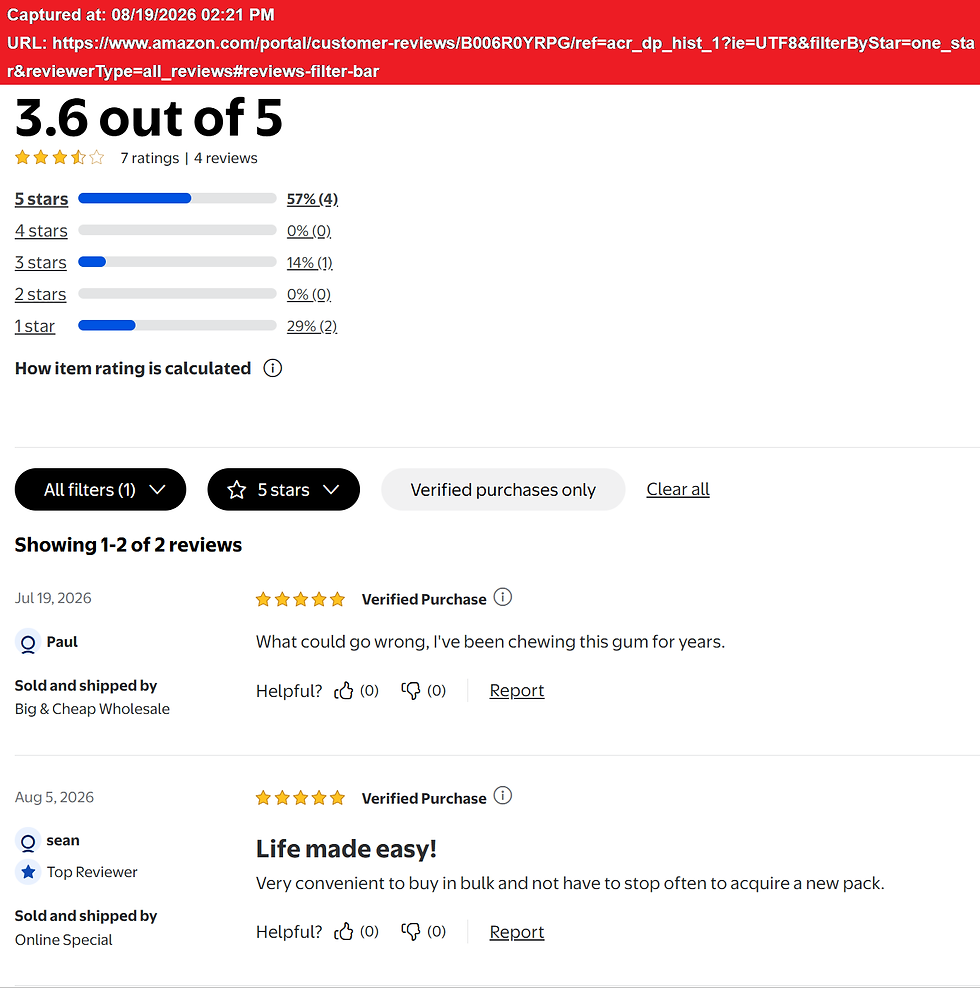
Walmart Dentyne Ice Arctic Chill Sugar-Free Chewing Gum Reviews
There are not a lot of reviews for this product on Walmart. The existing ones do not say much about the product quality. One claimed that they have been chewing it for years, but did not comment on its taste or flavor longevity or anything. Another complained about receiving a 9 pack instead of a 12 pack.

YouTube Dentyne Ice Arctic Chill Sugar-Free Gum Review 1
The reviewer describes Dentyne Ice Arctic Chill as a strong peppermint-flavored breath-freshening gum rather than a traditional bubble gum. He found the flavor quite intense and said it worked well for freshening breath, particularly after eating strong foods such as garlic or spicy meals. He viewed it as a convenient way to cleanse the palate and make the breath feel fresher.
YouTube Dentyne Ice Arctic Chill Sugar-Free Gum Review 2
The reviewer described the initial flavor as strong but said it felt more mellow and lasted longer than Dentyne Fire, which he found to deliver a more intense burst of flavor that fades faster.
He also noted that the gum is sugar-free and contains 5 calories per two-piece serving. He liked the easy-to-open packaging and the individual piece format, which makes the gum convenient to use. Overall, he considered Arctic Chill a good choice for people who want a strong mint flavor with longer-lasting freshness and enjoyed trying it as an alternative to his usual Dentyne Fire gum.
The Good
● Bold flavor: Dentyne Ice Arctic Chill delivers a strong peppermint flavor with a noticeable cooling sensation. The initial burst is particularly useful when you want a quick, refreshing feeling after a meal or before heading into a social situation.
● Sugar-free: The gum is sugar-free, making it an option for people who prefer to avoid added sugar in their chewing gum. The reviewer also noted that the package lists 5 calories per two-piece serving.
● Long-lasting freshness: Reviewers found Dentyne Ice Arctic Chill effective at keeping their breath fresh, particularly after meals or eating strong-smelling foods. One reviewer also felt that the freshness lasted longer than other Dentyne varieties they had tried.
● Convenient packaging: The small pieces are easy to remove from the package, and the compact format makes the gum convenient to carry in a bag, purse, car, or desk.
The Bad
● Flavor longevity may vary: Although one reviewer found the flavor longer-lasting than Dentyne Fire, the actual duration of the mint flavor and fresh feeling can vary from person to person. The advertised 60-minute freshness claim should therefore be viewed as a manufacturer claim rather than a guaranteed experience.
● Can be hard to find: Availability may depend on your location and retailer. One reviewer specifically mentioned getting the gum from Amazon, while another noted that it can be found at grocery and convenience stores. It may take some searching if local stores do not regularly stock it.
The Ugly
Dentyne Ice Arctic Chill uses artificial sweeteners such as aspartame along with sugar alcohols to keep the gum sugar-free. These ingredients are considered safe for most people when consumed within recommended amounts, but they may cause digestive discomfort when consumed in larger quantities.
Sugar alcohols, in particular, can have a laxative effect for some people when eaten in excess. While a single piece contains relatively small amounts, people who chew several pieces throughout the day should be mindful of how much sugar-free gum they consume. Those who are sensitive to these ingredients may want to limit their intake.
Ingredients
Sorbitol
Gum Base
Maltitol
Artificial and Natural Flavoring
Mannitol
Less than 2% of
Acacia
Acesulfame Potassium
Aspartame
BHT (to Maintain Freshness)
Candelilla Wax
Glycerin
Soy Lecithin
Sucralose
Titanium Dioxide (Color)
Health and Safety Concerns
Aspartame: A Contested Ingredient
Aspartame is an artificial sweetener used in Dentyne Ice Arctic Chill. In 2023, the International Agency for Research on Cancer (IARC), part of the WHO, classified aspartame as “possibly carcinogenic to humans” (Group 2B) based on limited evidence, including evidence related to liver cancer.
However, the WHO and FAO's food-additive committee, JECFA, reviewed the same evidence and kept the acceptable daily intake at 40 mg per kilogram of body weight per day. The FDA also did not agree with the IARC's classification.
This does not mean that aspartame is proven to cause cancer. The Group 2B category indicates limited evidence and uncertainty, and it is not the same risk category as established carcinogens such as tobacco or asbestos. Still, consumers who prefer to avoid aspartame as a precaution may reasonably choose products without it.
Sugar Alcohols: Sorbitol, Maltitol, and Mannitol
These sugar alcohols are generally safe in small amounts, but consuming too much can cause bloating, gas, stomach cramps, and diarrhea. This happens because some of the sugar alcohols are not fully absorbed by the body. The remaining portion reaches the colon, where it draws in water and is fermented by gut bacteria.
Maltitol may be more likely to cause digestive issues than sorbitol or mannitol because it is absorbed less completely. It is also fairly sweet, so it can be used in larger amounts in sugar-free products. For people who chew several pieces of gum a day, this can increase the chance of digestive discomfort.
Maltitol also has a higher glycemic impact than sorbitol or mannitol. This may matter to people who choose sugar-free products to help manage their blood sugar.
Overall, this is not a toxicity concern. The main concern is digestive tolerance, especially when consuming multiple pieces of sugar-free gum in a short period.
Titanium Dioxide (Color): A Regulatory Concern
Titanium dioxide is used as a coloring agent to give products a brighter, whiter appearance. It is a regulatory concern because different countries take different approaches to its safety. The European Union banned titanium dioxide as a food additive in 2022 after EFSA concluded that it could no longer be considered safe because concerns about possible genotoxicity, or DNA damage, could not be ruled out.
The U.S. takes a different position. The FDA continues to allow titanium dioxide as a food color additive, with use limited to 1% by weight of the food. Other countries, including Canada and Japan, also continue to permit its use in food.
There is also some important nuance around the EU's position. In 2025, the EU's highest court upheld the annulment of a separate classification that treated certain powdered forms of titanium dioxide as a suspected carcinogen when inhaled. This decision concerned inhalation exposure and did not reverse the EU's food-additive ban.
For consumers, the takeaway is that titanium dioxide is not a settled safety issue globally. Its presence does not automatically mean a product is dangerous, but the fact that the EU has removed it from food while the U.S. and other regulators continue to allow it makes it a reasonable ingredient to flag for consumers who prefer to avoid it.
BHT: A Mild-to-Moderate Concern
BHT (butylated hydroxytoluene) is a synthetic antioxidant used to help prevent ingredients from breaking down and becoming rancid. It is permitted for use in food in the U.S., including in chewing gum.
Safety concerns mainly come from animal research, where higher exposures have been associated with effects on the liver, thyroid, and other biological systems. However, EFSA previously concluded that BHT was not a genotoxic concern and established an acceptable daily intake of 0.25 mg per kilogram of body weight per day.
BHT is still being reviewed by the FDA as part of its ongoing assessment of chemicals used in food, so its safety remains an area of regulatory scrutiny. For the small amount found in chewing gum, this is better viewed as a precautionary concern rather than evidence that the gum is unsafe. People who prefer to limit synthetic preservatives may want to take BHT into consideration when choosing their gum.
Acesulfame Potassium and Sucralose: Low Concern
Acesulfame potassium (Ace-K) and sucralose are artificial sweeteners with extensive safety evaluations and are approved for use in food by the FDA. Recent EFSA reviews also found no safety concern at current permitted exposure levels for Ace-K, while its acceptable daily intake was set at 15 mg/kg of body weight per day.
Sucralose also remains considered safe for its currently authorized uses, with an acceptable daily intake of 15 mg/kg of body weight per day. Some research has raised questions about whether artificial sweeteners may affect the gut microbiome or metabolism, but these findings do not establish that the amounts typically consumed in products like chewing gum pose a serious health risk. For most consumers, these ingredients are a lower-priority concern compared with ingredients such as titanium dioxide, BHT, or aspartame.
Conclusion
Dentyne Ice Arctic Chill appears to be a legitimate sugar-free gum that delivers on its main purpose: freshening breath. The reviews we found were generally positive, with users liking its strong freshness, convenient packaging, and lasting effect. However, there were only a few independent reviews available, so there is limited consumer feedback to draw from.
The ingredient list is another consideration. The gum contains ingredients such as aspartame, sugar alcohols, titanium dioxide, and BHT, which may give some consumers pause. While these ingredients do not make the product inherently unsafe, people who prefer simpler ingredient lists may want to look at other options.
Overall, there is nothing to suggest that Dentyne Ice Arctic Chill is a scam or a product consumers should avoid outright. It is a reasonable option for those looking for convenient breath-freshening gum, but the limited review history and ingredient concerns make it a product worth approaching with some caution.
References
https://www.cancer.org/cancer/risk-prevention/chemicals/aspartame.html
https://www.fsai.ie/business-advice/running-a-food-business/food-safety-and-hygiene/additives/efsa-opinion-titanium-dioxide-(e171)-no-longer-con
https://efsa.onlinelibrary.wiley.com/doi/abs/10.2903/j.efsa.2012.2588
https://www.ecfr.gov/current/title-21/chapter-I/subchapter-B/part-172/subpart-B/section-172.115
https://www.ecfr.gov/current/title-21/chapter-I/subchapter-B/part-172/subpart-B/section-172.115
http://www.ewg.org/foodscores/ingredients/7397-ButylatedHydroxytolueneBHT/
http://www.ewg.org/news-insights/news/2026/06/dirty-dozentm-food-chemicals-bht
https://www.accessdata.fda.gov/scripts/interactivenutritionfactslabel/assets/InteractiveNFL_SugarAlcohols_October2021.pdf
https://www.sugar.org/wp-content/uploads/Sugar-Assoc-Citizen-Petition-to-FDA-June-3-2020.pdf
https://www.accessdata.fda.gov/drugsatfda_docs/nda/2011/022581Orig1s000PharmR.pdf
https://health.clevelandclinic.org/what-to-know-about-sugar-alcohols
https://glycemicindex.com/2019/03/food-for-thought-19/
https://www.packaginglaw.com/news/eu-court-justice-upholds-annulment-classification-titanium-dioxide-inhalation-carcinogen?utm_source=chatgpt.com


Comments